
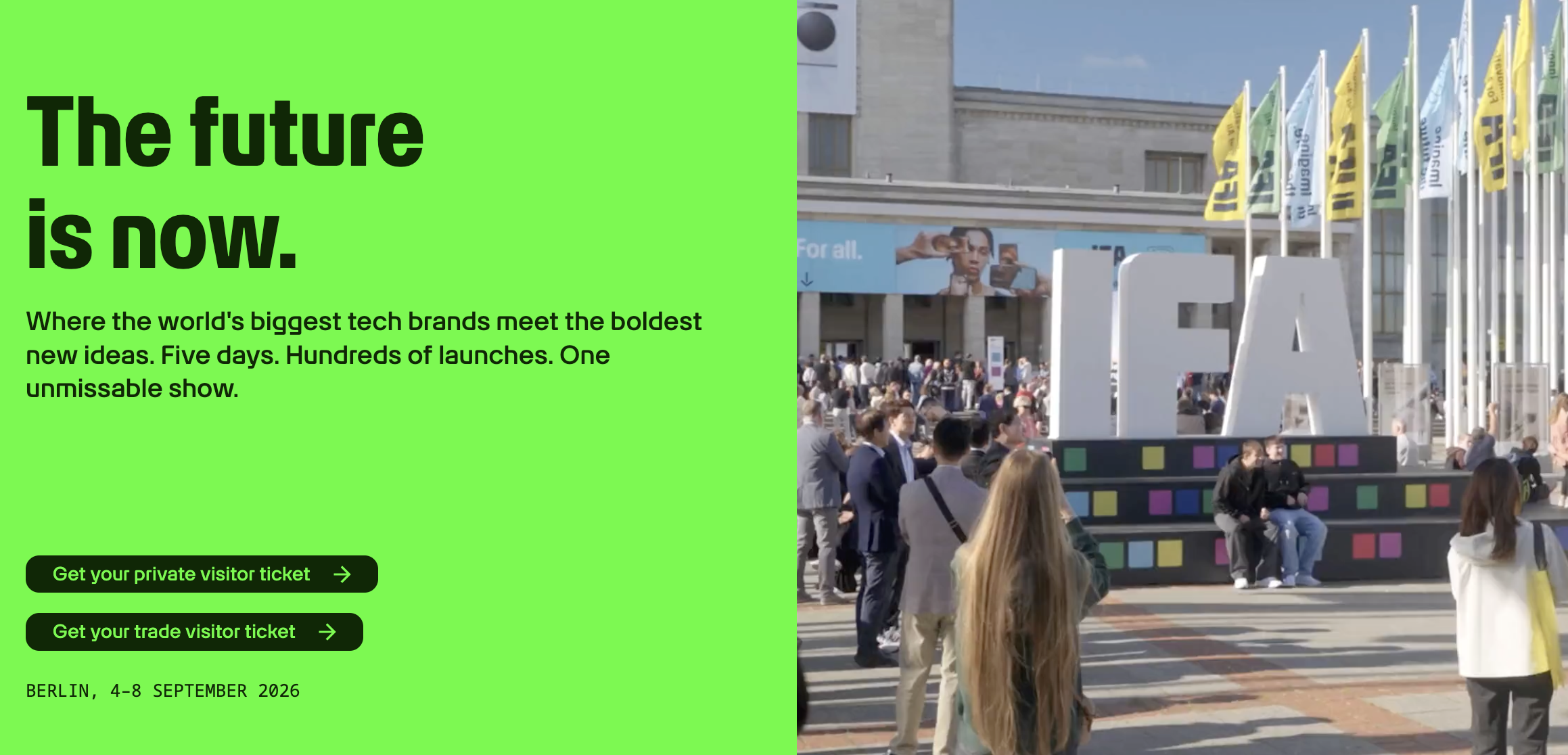
IFA 2026 opens at Messe Berlin on September 4–8 under the theme "The Future is Now" — the 102nd edition of the world's largest home and consumer tech event.
For consumer electronics and smart hardware brands expanding into Europe, the stakes are hard to overstate. IFA 2025 drew 220,000 visitors from 140 countries and 1,900 exhibitors; 67% of trade visitors were international retail buyers, and total media reach exceeded 301 billion impressions.
Yet most exhibitors spend six figures on a booth and let the story end at the hall doors. The brands that win IFA treat it as a content engine — and creators are the engine room. Here's the 2026 landscape, what to watch in Berlin, and the influencer marketing playbook we validated at CES 2026.
Consumer Electronics Trends Shaping IFA 2026
Five forces will dominate the Berlin narrative this September:
1. On-device AI becomes table stakes. AI in 2026 is ambient rather than app-driven; NPUs are standard silicon, and privacy-first, offline-capable features are the new selling points.
2. Smart homes go from connected to coordinated. Matter is the baseline, not the headline. The 2026 story is what's built on top: autonomous-mapping robot vacuums, appliances with edge AI, and energy-aware home systems — home turf for brands like Narwal, Ecovacs, and Dreame.
3. Health tech takes the top slot. IFA has elevated health and longevity tech to its primary editorial priority for 2026, with connected health among the fastest-growing categories.
4. Smart glasses outpace the market. AI eyewear growth is beating both the overall consumer electronics and wearables markets, powered by real-time translation and hands-free assistance that finally feels useful.
5. Modest growth, harder questions. US consumer tech revenue is projected at $565 billion in 2026 (+3.7% YoY), with the global market near $943 billion. Slower growth means every marketing dollar must be attributable — one reason over half of creator deals are now performance-based.
IFA 2026 Highlights Brands Should Watch
The Creator Hub is now core infrastructure. IFA's Creator Hub hosted 1,200+ creators in 2025 — up 50% year over year — and the organizers are expanding both the Creator Hub and Beauty Hub for 2026, alongside a dedicated Content Creation show area (Hall 17) and creator-specific tickets. IFA even runs its own Ambassador program with German tech creators. The signal: the show has moved from a retail-and-press model to retail, press, and creators.
AI voice, humanoid robots, and longevity tech will own the headlines. Expect these to generate the most shareable on-floor content — and the most crowded share-of-voice battles.
Chinese brands arrive in force. The official exhibitor list already confirms Anker Innovations (Hall 2.2), Dreame (Hall 7.1a), Xiaomi (Hall 6.2), TCL (Hall 21), Hisense (Hall 23), and Midea. Competition for attention within smart home and appliance halls will be fiercer than ever.
Computing and audio carry the AI story. New Intel, AMD, and Qualcomm-based laptops plus AI-powered audio (live translation, adaptive ANC) will launch in volume; the PR challenge is making AI claims feel substantive, not gimmicky.
The IFA Influencer Marketing Playbook: 4 Steps
Step 1 — Lock in creators 8–12 weeks out. Standard trade show marketing timelines call for planning six months ahead with pre-show campaigns launching 4–8 weeks before opening day. Top tech creators finalize their IFA schedules by July.
Build a two-tier roster: German and European tech creators for local retail credibility (remember that 67% buyer share), plus English-language tech channels for global reach. Select on predicted conversion fit — category track record and audience overlap — not follower counts. This is precisely what AI-powered creator matching is built for.
Step 2 — Design the booth as a content factory. Creators come to produce, not to pose. Give them material: first-person hands-on demos, side-by-side comparisons, three-minute founder Q&As, creator-only product previews. The industry has already moved this direction — at CES 2026, Omnicom announced creator-discovery integrations with Meta and Walmart Connect that index creator audiences directly to purchases, "beyond follower counts."
Step 3 — Run the three-phase content cycle. Tease before the show, publish live during it, then repurpose for 30 days after: recut edits, whitelisted ads, retail-page assets. Negotiate usage rights at contracting — partnership ads run from creator handles earn 30–40% higher engagement than brand-handle equivalents.
Step 4 — Report attribution, not applause. An IFA campaign report needs three layers: exposure (views, engagement), behavior (site traffic, promo codes, affiliate links), and business impact (6–12 month LTV of acquired customers). Brands using multi-touch attribution measure 34% higher ROI than last-click — critical for trade show campaigns, where the view-to-purchase gap often spans weeks.
Case Study: What Worked at CES 2026
We stress-tested this playbook at CES 2026 with YouTube creator campaigns for over 10 consumer electronics clients including LiberNovo, ECOVACS ROBOTICS, Aqara, EcoFlow, DREO, Govee, Lymow Tech, Soocas, Euhomy, ANTHBOT, and Narwal Robotics.
The approach: creator selection from a pool of 10K+ macro to mega tech channels ten weeks before the show, on-floor first-person demos and exclusive previews published same-day to capture "CES 2026" search demand, then a 30-day post-show repurposing cycle. Results: 240 Million total impressions brought by 42 top tech creators.
The same methodology transfers directly to IFA — with one difference in Europe's favor: local-language creator credibility matters even more in a retail-buyer-heavy environment, which raises the value of precise creator matching.
FAQ
When is IFA 2026? September 4–8, 2026, at Messe Berlin, Germany.
Can brands run IFA influencer campaigns without exhibiting? Yes. Off-site review content timed to IFA news cycles captures "IFA 2026" search and social demand at a fraction of booth cost.
How should an IFA influencer budget split? A working benchmark: 50–60% creator fees, 15–20% production, 20–30% paid amplification, plus usage rights.
📩 IFA 2026 is under two months away — creator calendars are filling now. Get Started and drop us your request today if you would like to explore growth.