
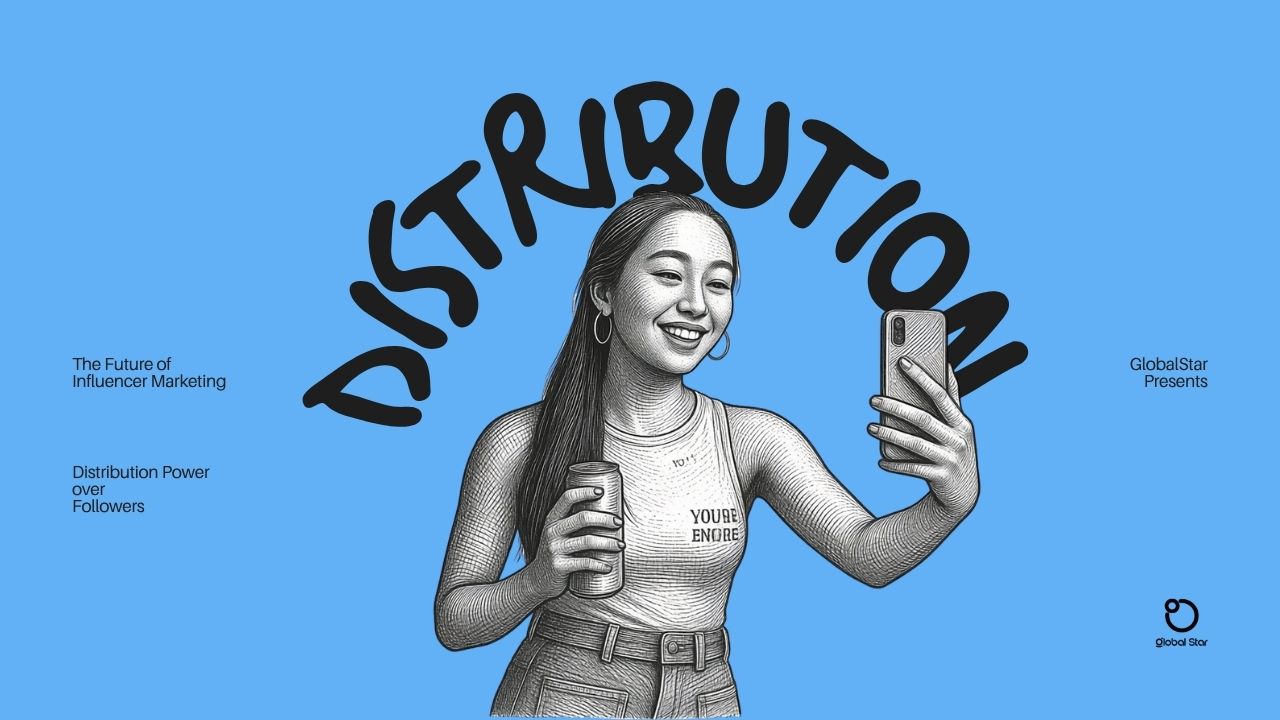
Influencer marketing is entering a completely new era.
For years, brands approached creator campaigns primarily as awareness tools. Success was measured through impressions, likes, shares, and occasional viral moments. A creator with millions of followers could command enormous budgets simply because they had attention. The assumption was straightforward: more followers meant more influence, and more influence meant better marketing results.
But the industry is changing rapidly.
In 2026, influencer marketing is no longer just about visibility. It is becoming a sophisticated performance-driven ecosystem where distribution strategy, paid amplification, platform algorithms, and conversion optimization matter just as much — if not more — than follower count alone.
This shift is redefining how brands work with creators, how campaigns are structured, and what businesses should expect from influencer agencies.
At GlobalStar Digital, we believe the future belongs to brands that understand one critical reality:
The most valuable creator content is not simply content that gets seen. It is content that can be strategically distributed, scaled globally, and transformed into measurable business growth.
The End of the “Organic Reach” Era
A few years ago, influencer marketing operated in a relatively simple environment.
Creators posted content to their audiences, and brands benefited from direct exposure. Organic reach on platforms like Instagram, TikTok, and YouTube was significantly higher than it is today. A strong creator partnership alone could generate millions of impressions without additional media investment.
Today, that landscape looks very different.
Social platforms have evolved into highly competitive algorithm-driven ecosystems. Every platform is prioritizing personalized feeds, retention metrics, and monetization opportunities. As a result, even creators with large audiences often struggle to consistently reach all of their followers organically.
This does not mean influencer marketing is becoming less effective.
In fact, creator content is more valuable than ever.
But the way successful campaigns operate has fundamentally changed.
Brands can no longer rely solely on organic creator distribution. Instead, they must combine creator partnerships with strategic amplification strategies that maximize reach, engagement, and conversion performance across multiple channels.
This is where modern influencer marketing begins to resemble performance media.
Creator Content Is Becoming Performance Media
One of the biggest transformations happening in the industry is the evolution of creator content into scalable advertising assets.
Traditionally, influencer campaigns were treated separately from paid media campaigns. Marketing teams often divided budgets between “brand awareness” and “performance advertising.”
Today, those lines are disappearing.
The most successful brands are now integrating creator content directly into their paid media ecosystems. Instead of relying on a single sponsored post, they repurpose creator videos into TikTok Spark Ads, Instagram Reels ads, YouTube Shorts campaigns, Meta conversion campaigns, and cross-platform performance funnels.
Why?
Because creator-generated content consistently outperforms traditional branded advertising.
Consumers trust creators more than polished corporate ads. Creator content feels authentic, native to the platform, and emotionally relatable. It captures attention faster and often generates stronger engagement and conversion rates.
However, the real advantage comes when brands combine authenticity with strategic distribution.
A creator video that performs well organically can become exponentially more powerful when amplified through paid media targeting. Instead of reaching only a creator’s audience, brands can distribute high-performing content to highly specific customer segments around the world.
This creates a scalable growth engine.
And it changes the role of influencer agencies entirely.
Why Influencer Agencies Must Evolve
In the past, many influencer agencies focused primarily on talent sourcing and campaign coordination.
Their responsibilities included:
- Finding creators
- Negotiating rates
- Managing deliverables
- Tracking basic engagement metrics
While these functions remain important, they are no longer enough.
Modern influencer marketing requires a much deeper understanding of platform ecosystems, audience behavior, creative strategy, and performance optimization.
The agencies leading the next generation of creator marketing are not simply intermediaries between brands and influencers.
They are strategic growth partners.
At GlobalStar Digital, we believe successful influencer campaigns now require expertise across five critical areas:
1. Creator Selection Based on Performance Potential
Follower count alone is no longer the best predictor of campaign success.
Today, brands must evaluate creators based on:
- Audience quality
- Engagement authenticity
- Content style
- Conversion potential
- Platform alignment
- Creative adaptability
Micro and mid-tier creators often outperform celebrity influencers because their audiences are more engaged and niche-focused.
The right creator is not necessarily the biggest creator.
It is the creator whose content can drive measurable business outcomes.
2. Platform-Native Content Strategy
Every platform has its own culture, pacing, and content language.
What works on TikTok may fail on Instagram. What succeeds on YouTube Shorts may not perform on Snapchat or Xiaohongshu.
Modern influencer campaigns require platform-native storytelling that feels organic within each ecosystem.
This means understanding:
- Hook structures
- Video pacing
- Editing styles
- Caption psychology
- Audience behavior patterns
- Trend integration
The goal is not simply to create content.
The goal is to create content that algorithms want to distribute.
3. Paid Media Amplification
One of the biggest misconceptions in influencer marketing is that creator partnerships alone guarantee scale.
In reality, paid amplification is increasingly essential.
Strategic media support allows brands to:
- Extend campaign lifespan
- Improve targeting precision
- Increase conversion efficiency
- Retarget engaged audiences
- Scale winning creative assets globally
The combination of creator authenticity and paid distribution creates significantly stronger performance than either strategy alone.
This hybrid model is becoming the future of influencer marketing.
4. Cross-Platform Distribution
Consumers no longer exist on a single platform.
A customer may discover a product on TikTok, research it on YouTube, encounter retargeting ads on Instagram, and finally convert through Amazon or Shopify.
This means influencer campaigns must operate across interconnected digital ecosystems.
Brands that rely on isolated creator posts are missing enormous opportunities.
At GlobalStar Digital, we focus on building integrated creator ecosystems where content flows strategically across platforms to maximize visibility, engagement, and conversion.
5. Data-Driven Optimization
The influencer industry is becoming increasingly performance-oriented.
Brands now expect measurable ROI.
This requires agencies to move beyond vanity metrics and focus on:
- Customer acquisition cost
- Conversion rates
- Retention metrics
- Revenue attribution
- Audience quality
- Incremental lift
Data is no longer optional.
It is the foundation of scalable influencer marketing.
The Rise of Global Creator Commerce
Another major trend shaping the future of influencer marketing is globalization.
Social platforms have eliminated geographic barriers. A creator in Seoul can influence purchasing behavior in Los Angeles. A TikTok trend in Tokyo can drive product demand in Europe within days.
This creates enormous opportunities for brands willing to think internationally.
However, global creator campaigns require more than translation.
They require cultural understanding.
Different markets respond to different storytelling styles, humor, aesthetics, and platform behaviors. Successful international campaigns must balance global consistency with local relevance.
At GlobalStar Digital, we specialize in helping brands navigate this complexity by combining global strategy with localized creator expertise.
The future of influencer marketing is not local.
It is borderless.
Why Authenticity Still Matters
As influencer marketing becomes more performance-driven, some brands worry that campaigns may lose authenticity.
But authenticity remains the foundation of creator success.
The difference is that authenticity alone is no longer enough.
The future belongs to brands that can combine:
- Authentic storytelling
- Strategic distribution
- Performance optimization
- Platform intelligence
- Creative scalability
Consumers still want human connection.
They still trust creators who feel relatable and genuine.
The challenge for brands is learning how to scale that trust effectively.
The New Definition of Influence
The definition of influence itself is evolving.
In the past, influence was measured primarily through audience size.
Today, influence is increasingly measured through:
- Attention retention
- Community trust
- Conversion impact
- Content adaptability
- Distribution scalability
A creator with a smaller but highly engaged audience may generate significantly stronger business results than a celebrity with millions of passive followers.
This shift is creating a more sophisticated and results-oriented creator economy.
And it is forcing brands to rethink how they evaluate marketing success.
The Future Belongs to Strategic Distribution
The influencer marketing industry is not shrinking.
It is maturing.
Brands are becoming more selective, more analytical, and more focused on measurable outcomes. Platforms are prioritizing paid distribution ecosystems. Consumers are demanding more authentic and engaging content experiences.
In this environment, creator partnerships alone are no longer enough.
The future belongs to brands that understand how to combine creators, content, media buying, platform strategy, and performance analytics into one integrated growth system.
At GlobalStar Digital, we believe influencer marketing is evolving into something far more powerful than traditional sponsorships.
It is becoming a scalable global distribution engine for modern brands.
The future of influencer marketing is no longer just about who creates content.
It’s about who can distribute it effectively, scale it globally, and turn creator attention into measurable business growth.
It is about who can distribute it effectively, scale it intelligently, and transform creator attention into sustainable business growth.