
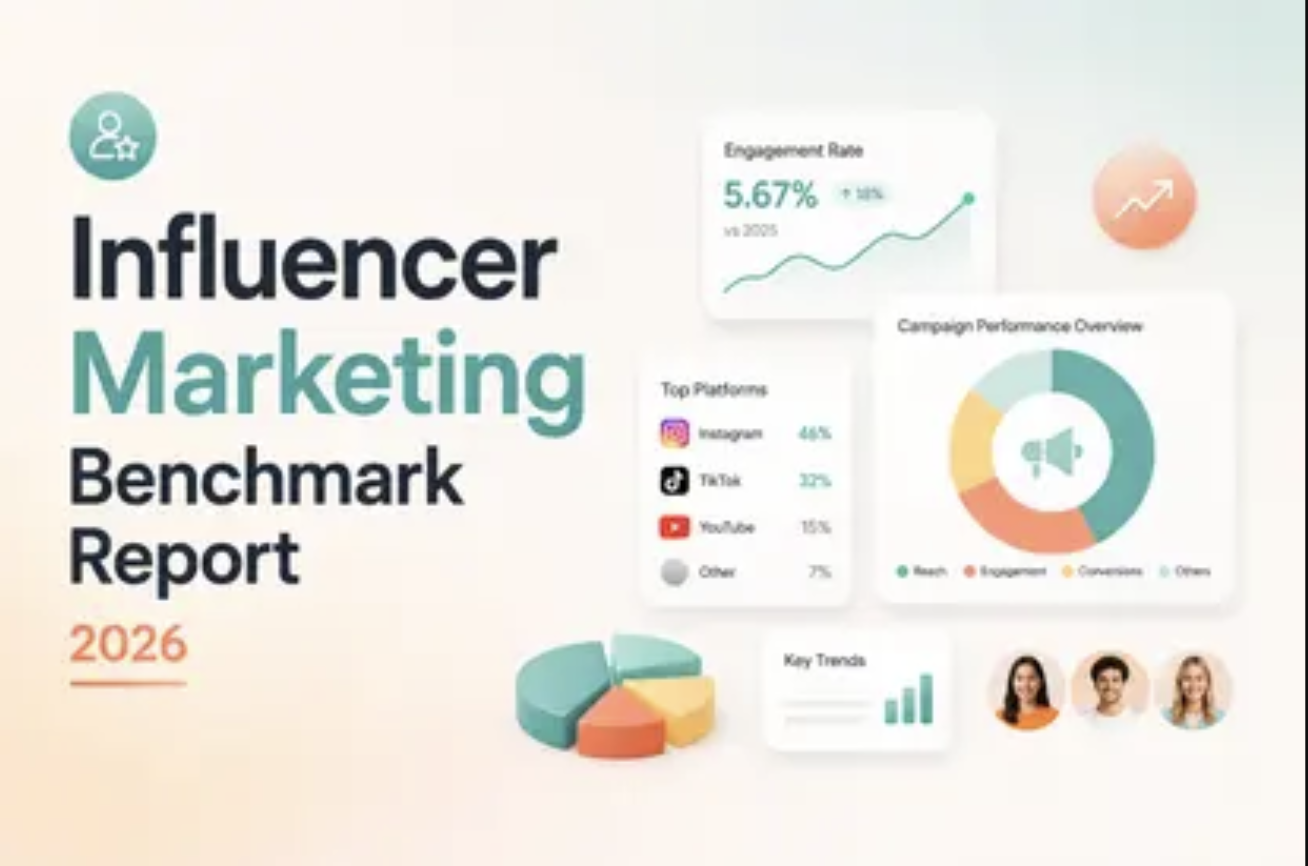
Influencer Marketing Hub's 2026 Benchmark Report — the industry's most-watched annual survey, based on 600+ marketing professionals — dropped earlier this year. For consumer electronics and smart hardware brands building creator programs in the US and Europe, it reads less like a trend piece and more like an operating manual. Here are the seven data points that matter most, and what to do about each.
1. Budgets are surging — and so is competition for good creators
87.49% of respondents expect their influencer budget to increase in 2026, and 72.22% expect it to grow by 50% or more.
Only 5.55% plan a decrease.
The practical consequence: creator inboxes are getting noisier, the best tech reviewers get booked earlier, and rates climb quarter over quarter. For brands entering the US or Europe, waiting a season no longer means the same market at the same price.
2. Payback expectations are brutally short
65.9% of marketers expect campaign payback within one month — 48.4% within two weeks.
Hardware doesn't always work that way: a $300 robot vacuum or a power station is a considered purchase. Meta's own reporting shows 71% of consumers buy within a couple of days of seeing creator content when the path-to-purchase is tight, but for higher-ticket electronics you need attribution that can also see the 30–90 day window.
Set payback expectations by price point and funnel stage, or your program will look like a failure while it's actually working.
3. AI creator matching is now the industry's #1 priority
26.89% of marketers named AI creator matching their top 2026 focus — more than any other initiative — and creator discovery is already the most common AI use case (36.67%). Only 10.56% report not using AI at all.
Meanwhile, industry estimates put manual creator screening at 20–40 hours per campaign. The question has shifted from "should we use AI to find creators?" to "whose AI, trained on what campaign data?"
4. The money is moving to micro and nano creators
Micro creators show 52.83% expansion intent (and 0% of respondents plan to stop working with them); nano creators are at 51.43%. Macro creators are essentially flat — 20.59% expansion versus 20.58% contraction.
Pricing explains part of it: roughly 45.5% of reported micro-creator rates sit under $500 per post. For electronics — a category where products need demonstration, education, and trust built over time — this validates the portfolio approach: dozens of well-matched micro creators typically outperform a single celebrity placement.
5. Fraud is an audience problem, not a content problem
56.5% of all reported fraud and quality issues are fake or bot followers, with another 20.8% tied to engagement integrity (templated comments at 10.6%, purchased engagement at 10.2%). Separately, a WFA study of 1,400 senior marketers found 81% encountered influencer fraud within 12 months, with a 37% average gap between projected and authentic reach — a median waste of $128K per mid-scale campaign.
None of this is visible from a creator's profile page. It only surfaces with audience-level screening, at scale, before the contract is signed.
6. Brands outsource discovery — but keep the truth layer
Creator discovery and vetting is the most outsourced function in influencer marketing (19.44% of selections), while reporting and analytics is the least (6.9%).
The message is clear: brands want partners for sourcing speed and screening capacity, but they insist on owning performance data. Whatever platform or agency you work with should hand you transparent, first-party attribution — not an agency-defined ROI narrative.
7. Measurement is lagging the money
Brands planning 50%+ budget growth make up 72.22% of respondents but only 64.23% of measurement-tool adoption — scale is outrunning instrumentation. Current measurement still leans on promo codes (45.9%), affiliate links (26.0%), and native shop features (25.0%).
One more caution flag: TikTok is the most-selected platform for 2026 investment (31%) — and also the most-selected among brands planning to cut back (39%).
Scaling a channel without measurement is how brands end up in that second group.
What this means for your 2026 US/EU launch plan
Three moves, in order.
First, replace manual screening with AI matching that scores creators on audience authenticity and historical performance — not follower counts.
Second, build a micro-first creator portfolio for education-heavy products.
Third, put attribution infrastructure in place before you scale budget, not after.
This is the model GlobalStar runs for consumer electronics brands like Anker, Ugreen, Narwal, Ecovacs, and EcoFlow: an AI matching engine trained on consumer-electronics campaign data, full campaign management, and attribution reporting your finance team can audit.